
GOGO Rummy Legality
Online rummy platforms such as GOGO Rummy operate in a legally complex but established regulatory environment in India. The legality of such platforms is not defined by a single federal law but instead by a combination of central statutes, judicial interpretations, and state-level gaming rules.
India does not have a unified gambling law. Instead, the primary reference point is the Public Gambling Act of 1867, a colonial-era law that prohibits running or visiting a “gaming house.” However, this law does not clearly address online gaming or skill-based card games.
The most important legal distinction in India is between:
- Games of skill (legal in most states)
- Games of chance (restricted or illegal in many states)
Rummy has been repeatedly classified by Indian courts as a game of skill, meaning that outcomes depend significantly on strategy, memory, and decision-making rather than pure chance.
This classification is the foundation on which platforms like GOGO Rummy operate.
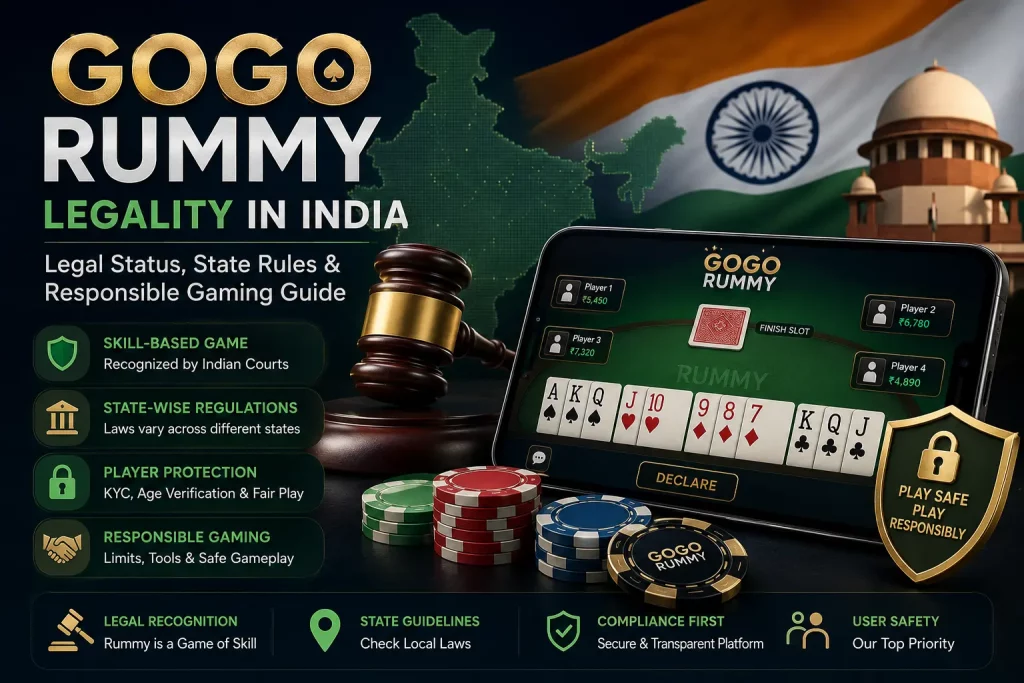
Legal Interpretation of Rummy in India
The Supreme Court of India has ruled in multiple cases that rummy is a skill-based game when played with real strategy and not purely for gambling purposes.
This legal interpretation allows rummy platforms to function in most Indian states, provided they follow certain compliance norms:
- No promotion of gambling addiction
- Age restrictions (18+ only)
- KYC verification for users
- Responsible gaming policies
However, legality still varies by state jurisdiction, making it essential for users to understand local regulations before participating.
Dark Theme Legal Overview
| Legal Factor | Status in India | Impact on GOGO Rummy |
|---|---|---|
| Public Gambling Act 1867 | Outdated / Partial coverage | Does not clearly ban online rummy |
| Skill vs Chance Law | Skill games allowed | Rummy considered legal skill game |
| State Regulations | Varies by state | Access may be restricted in some states |
| Online Gaming Laws | Evolving framework | Platforms must comply with IT rules |
State-Level Variation
One of the most important aspects of legality is that India does not treat all states equally when it comes to real-money gaming.
Some states allow skill-based gaming freely, while others impose partial or full restrictions on real-money gaming apps.
This creates a fragmented legal environment where platforms must adapt dynamically to compliance requirements.
GOGO Rummy typically implements geo-restrictions to ensure users from restricted regions cannot access real-money gameplay features.
Industry Compliance Standards
To operate legally and responsibly in India, platforms like GOGO Rummy usually implement:
- Age verification (18+ restriction)
- Identity verification (KYC)
- Anti-fraud systems
- Fair play algorithms
- Secure payment gateways
- Responsible gaming tools
These measures are not only legal safeguards but also essential for maintaining trust in the online gaming ecosystem.
The legality of GOGO Rummy in India is primarily based on the classification of rummy as a game of skill, which allows it to operate in most regions under regulated conditions. However, the legal environment remains dynamic, and compliance with state rules is essential for continued access.
The legal environment surrounding online rummy in India is shaped less by a single unified law and more by a combination of judicial interpretation, state-level regulation, and evolving digital gaming policies. This creates a framework where legality is not absolute but depends heavily on geography and enforcement boundaries.
At the core of this structure is the distinction between skill-based games and chance-based gambling, which continues to define how platforms like GOGO Rummy operate across the country. While courts have consistently recognized rummy as a skill-based game, states retain the authority to impose their own restrictions, especially when real-money participation is involved.
This means that legality is not just a theoretical concept — it is actively influenced by where a user is physically located at the time of play.
How State Regulation Shapes Access
In practice, India’s states can be grouped into three broad regulatory approaches:
Some states allow unrestricted participation in skill-based gaming platforms, treating rummy as a legal competitive activity. Others permit access but introduce limitations specifically around cash-based gameplay. A smaller group of states enforces stricter controls or outright restrictions on real-money gaming.
This layered system creates a dynamic environment where platforms must continuously adapt their access rules to remain compliant.
For users, this often results in different experiences depending on their region — including variations in gameplay availability, payment options, and promotional access such as Login Bonus, Sign up rewards, or even certain game modes like Slots APK Links integrations where applicable.
Compliance Strategy Used by Platforms
To function legally across multiple jurisdictions, platforms such as GOGO Rummy typically rely on automated compliance systems. These systems determine whether a user can access real-money features based on location and regulatory permissions.
The most important compliance mechanisms include real-time geo-verification, identity confirmation through KYC checks, and financial safeguards that monitor transaction legitimacy. Together, these systems ensure that gameplay remains within legal boundaries while still offering access to eligible users.
This structure allows platforms to operate in a legally fragmented environment without violating state-specific restrictions.
Legal Distribution
| Regulatory Category | Description | User Impact |
|---|---|---|
| Fully Permitted States | Allow skill-based rummy without restrictions | Full access to all features |
| Conditional States | Allow gameplay but restrict cash involvement | Limited real-money features |
| Restricted States | Block or heavily regulate real-money gaming | Partial or no access |
Legal Interpretation in Real-World Usage
Although legal classification is relatively stable at the national level, its practical enforcement continues to evolve. Courts have reinforced the idea that skill-based gaming is fundamentally different from gambling, but they have also emphasized that misuse, misleading promotion, or lack of responsible gaming safeguards can change regulatory perception.
Because of this, platforms must maintain transparency not only in gameplay mechanics but also in how features are presented to users. This includes how promotional systems like Login Bonus or onboarding flows like Sign up are structured, ensuring they remain compliant with advertising and digital platform rules.
Regional Legal Access Overview
The legal status of GOGO Rummy is not determined by a single authority but emerges from a combination of judicial recognition and state-level enforcement. This creates a flexible but complex system where compliance technology becomes essential for maintaining lawful operation across different regions.
Regulatory Focus on Player Safety
Responsible gaming is a central part of how online rummy platforms are evaluated under Indian digital gaming expectations. Even though rummy is legally recognized as a skill-based game, regulators and courts consistently emphasize that platforms must actively protect users from financial harm and addictive behavior.
This means legality is not only about whether the game is allowed, but also about how safely it is operated. Platforms like GOGO Rummy must demonstrate that they provide a controlled environment where users can participate responsibly.
A key principle is transparency — users must clearly understand risks, rules, and financial conditions before engaging in real-money gameplay.
Core Protection Mechanisms
Modern gaming platforms implement multiple layers of protection to ensure compliance with legal and ethical standards. These systems are not optional — they are essential for maintaining operational legitimacy in India.
The most important mechanisms include identity verification, age restriction (18+), fraud detection, and financial monitoring systems. Together, they create a structured environment that reduces risk and ensures fair participation.
Promotional elements such as Login Bonus, Sign up offers, and feature-based engagement like Slots APK Links must also follow strict transparency rules to avoid misleading users or creating unrealistic expectations.
Responsible Gaming
| Protection Layer | Purpose | User Impact |
|---|---|---|
| Age Verification | Ensures only 18+ users access real-money games | Prevents underage participation |
| KYC Checks | Identity validation for withdrawals | Increases financial security |
| Deposit Limits | Controls spending behavior | Reduces risk of overspending |
| Fraud Monitoring | Detects suspicious activity | Protects fair gameplay |
Financial Compliance & Transparency
Another major pillar of legality is financial compliance. All transactions on regulated gaming platforms must pass through secure payment systems that comply with Indian financial regulations and anti-money laundering standards.
This includes encrypted payment processing, verified withdrawal systems, and full traceability of funds. Such measures ensure that gaming activity remains transparent and legally defensible.
Without these safeguards, platforms risk being classified as non-compliant even if the game itself is legally recognized.
Responsible Gaming Distribution
Why Responsible Gaming Matters Legally
Responsible gaming is not just a UX feature — it is a legal safeguard requirement. Courts and regulators expect platforms to actively prevent misuse and ensure that users engage in a controlled, transparent environment.
Failure to implement these systems can lead to regulatory scrutiny, reputational damage, or loss of operational legitimacy in certain regions.
This is why compliance is tightly integrated into both gameplay systems and promotional structures.
The legality of platforms like GOGO Rummy in India depends not only on game classification but also on how responsibly the platform operates. Strong player protection systems, transparent financial controls, and ethical design principles are essential for maintaining long-term legal stability.
Overall Legal Position of Online Rummy in India
The legality of online rummy in India is best understood as a hybrid legal framework shaped by judicial rulings, state-level restrictions, and evolving digital regulations. While rummy has been consistently recognized as a game of skill, its real-money implementation is still subject to strict compliance rules that vary across jurisdictions.
Platforms like GOGO Rummy operate within this environment by adapting access based on location, enforcing identity verification, and ensuring that all gameplay features comply with responsible gaming standards.
The result is not a uniform national rule, but a flexible system where legality depends on both the nature of the game and the region in which it is played.
Compliance as the Core Legal Requirement
In modern online gaming regulation, compliance is just as important as legal classification. Even if a game is legally recognized, platforms must still demonstrate operational integrity.
This includes ensuring fair gameplay mechanics, preventing underage access, securing financial transactions, and maintaining transparency in promotional features such as Login Bonus, Sign up incentives, and game integrations like Slots APK Links.
Without these safeguards, platforms risk falling outside acceptable regulatory standards even if the game itself remains legal.
Market Outlook and Future Regulation
India’s online gaming market continues to evolve rapidly. Regulatory discussions increasingly focus on taxation frameworks, digital gaming classification, and uniform national guidelines.
In the future, it is likely that India will move toward a more centralized regulatory structure, reducing the current state-by-state fragmentation. This would simplify compliance for platforms and create a clearer legal environment for users.
Until then, platforms must continue operating within a dual system of national judicial interpretation and state-level enforcement.
Legal Summary
| Legal Aspect | Current Status | Impact on Platforms | User Effect |
|---|---|---|---|
| Game Classification | Recognized as skill-based game | Legally operable in most states | Access allowed in regulated format |
| State Regulations | Fragmented regional laws | Geo-restriction required | Availability varies by location |
| Financial Compliance | Strict banking & AML rules | Secure payment systems mandatory | Verified deposits & withdrawals |
| Responsible Gaming | Mandatory compliance feature | User protection systems required | Safer gameplay experience |
| Advertising Rules | Strict transparency requirements | No misleading promotions | Clear bonus & offer conditions |
The legal position of GOGO Rummy in India reflects a balanced ecosystem where skill-based recognition enables operation, but compliance obligations define sustainability. As regulations continue to evolve, platforms that prioritize transparency, responsible gaming, and regional compliance will remain the most stable within the market.
Frequently Asked Questions
Is online rummy legal in India?
Online rummy is generally considered legal in India because it is classified as a game of skill by multiple court rulings. However, access depends on state regulations and compliance rules applied by each platform.
Why is legality different in each state?
India follows a federal system where states can regulate gaming activities independently. This creates differences in how real-money gaming is allowed, restricted, or monitored across regions.
Do platforms like GOGO Rummy require KYC verification?
Yes. KYC verification is mandatory for withdrawals and is part of financial compliance rules designed to prevent fraud, underage access, and identity misuse.
Can users access Login Bonus and Sign up offers everywhere?
Not always. Features like Login Bonus and Sign up promotions may vary depending on regional restrictions and responsible gaming compliance rules.
Are APK Links and Slots features legal?
These features are not illegal by default, but their availability depends on local laws, platform compliance policies, and responsible gaming regulations.